

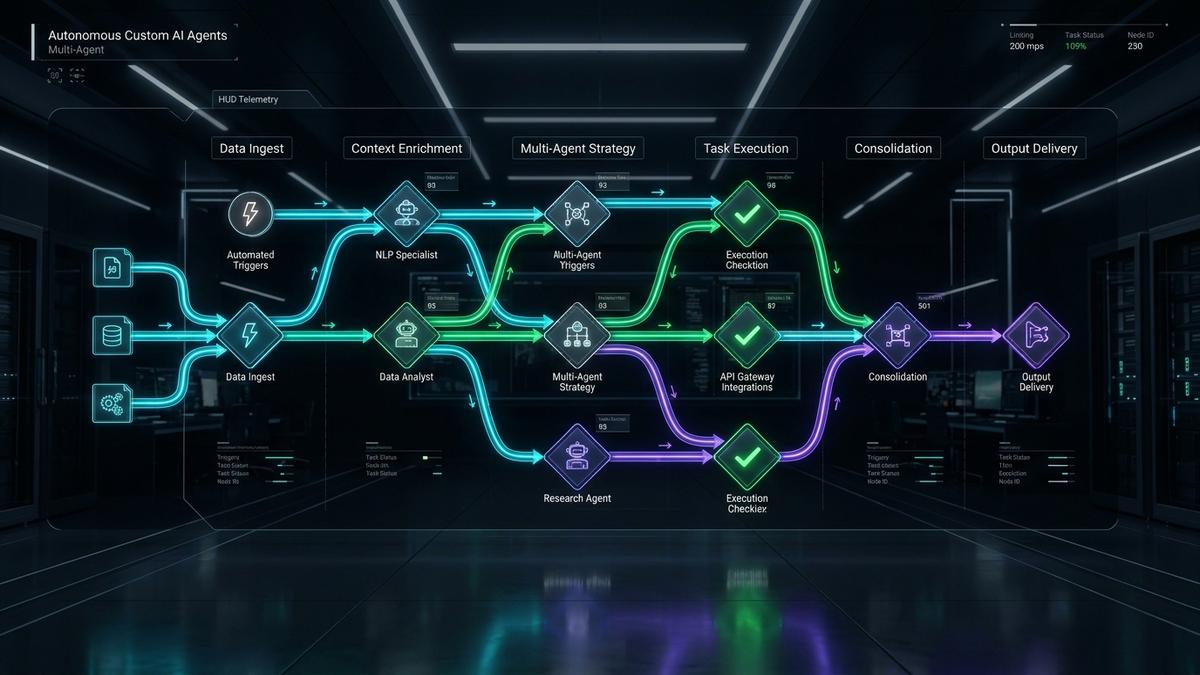
Over the past twenty-four months, enterprise awareness of artificial intelligence has matured rapidly. Organizations that initially experimented with generic chatbots and internal prompt assistants have arrived at an unavoidable realization: conversational interfaces that merely generate text do not solve operational bottlenecks. Real business traction is not achieved by asking an AI to write an email; it is achieved when an autonomous digital worker reads incoming data, makes verifiable decisions within established business rules, and executes end-to-end multi-step tasks across your entire software ecosystem.
This paradigm shift marks the transition from passive chatbots to active autonomous digital workers. At Apex Expansion, we engineer turnkey autonomous systems that bridge disconnected databases, eliminate repetitive administrative triage, and operate complex business workflows with mathematical consistency 24 hours a day, without human fatigue.
1 Defining the Autonomous Digital Worker
To appreciate the true practical impact of custom AI agents, one must understand how their architecture differs from standard generative language models. A basic LLM is stateless and reactive; it waits for a user prompt, generates a probable sequence of words, and immediately ceases execution.
An autonomous agent, by contrast, is an active decision-making system equipped with four foundational capabilities:
The Core Architecture of an Autonomous Agent
- Persistent Memory Architecture: Maintains short-term operational state across complex multi-hour tasks, paired with long-term vector memory of internal company documents and transaction histories.
- Tool Use & API Execution: Possesses programmatic access to internal software APIs, database queries, webhook triggers, web scraping tools, and messaging protocols.
- Goal-Oriented Planning Engines: Deconstructs high-level business objectives (e.g., “Process incoming logistics tenders, verify carrier rate compliance, and draft booking confirmations”) into ordered, deterministic sub-tasks.
- Reflection and Error Correction: Inspects the output of each API call or action, evaluates whether the result satisfies the objective, and autonomously adjusts parameters if an error occurs.
These components transform artificial intelligence from a passive conversational novelty into a tireless digital worker capable of owning mission-critical workflows from start to finish.
2 Multi-Agent Coordination: The Power of Specialized Roles
One of the most frequent architectural mistakes made by novice AI developers is attempting to build a single monolithic agent that handles every aspect of an enterprise workflow. Large language models struggle when overloaded with dozens of disparate instructions, leading to degraded reasoning and hallucinations.
Enterprise-grade architectures rely on multi-agent collaboration deploying specialized digital workers that operate in sequential or hierarchical coordination:
Consider an automated lead enrichment and proposal workflow engineered by Apex Expansion:
- Agent 01 (The Ingestion Agent): Monitors incoming inbound leads across web forms and emails, extracts structured data fields, and sanitizes input text.
- Agent 02 (The Research & Enrichment Agent): Queries external public registries, LinkedIn APIs, and financial databases to enrich company headcount, tech stack, and revenue brackets.
- Agent 03 (The Pricing & Logic Agent): Cross-references the enriched profile against your internal rate cards, calculates custom tiered pricing, and validates profit margins.
- Agent 04 (The Proposal Drafting Agent): Populates customized contract templates, generates branded PDF proposals, and stages the document for executive sign-off.
- Agent 05 (The Notification & Sync Agent): Updates your CRM pipeline status, dispatches customer communications, and pings your account executive team on Slack with full context.
By dividing responsibilities among dedicated micro-agents, each agent executes with razor-sharp precision, complete auditability, and zero cross-task contamination.
3 Deep Integration Across the Modern Enterprise Tech Stack
An autonomous agent is only as valuable as the software tools it can command. A digital worker that cannot read your database or write to your CRM remains an isolated intellectual toy.
At Apex Expansion, our engineering philosophy prioritizes native, secure API integrations. We integrate custom digital workers directly into the enterprise platforms your company already relies upon:
- CRMs & Marketing Platforms: HubSpot, Salesforce, Pipedrive, ActiveCampaign.
- ERPs & Operations: SAP, Oracle NetSuite, QuickBooks, custom SQL/PostgreSQL databases.
- Communication & Collaboration: Slack, Microsoft Teams, Discord, Twilio, WhatsApp Business.
- E-Commerce & Billing: Shopify, WooCommerce, Stripe, Chargebee, PayPal.
- Project & Task Management: Jira, Asana, ClickUp, Linear, Notion.
If an enterprise platform features a REST API, GraphQL endpoint, or webhook architecture, our agents can orchestrate it reliably.
4 Enforcing Deterministic Guardrails and Safety Boundaries
In high-compliance commercial environments, autonomous action cannot exist without absolute predictability. Enterprise leaders must possess unshakeable confidence that digital workers will never deviate from established policy.
We enforce security and compliance through multi-tier deterministic guardrails:
Explicit Action Allow-lists: The agent cannot perform any action outside its strictly defined programmatic sandbox. If a task requires modifying financial data, it can only execute pre-approved parameter schemas.
Financial & Volume Rate Limits: Hard programmatic limits govern daily transaction volumes, outbound message frequency, and spending thresholds. Any operation exceeding threshold parameters triggers an automated freeze and administrative alert.
Human-in-the-Loop Verification: For high-stakes decisions (e.g., executing refunds above $500, sending binding contracts, or modifying user permissions), the agent compiles the complete rationale and requests a one-click human authorization before final dispatch.
5 Observability and Immutable Execution Audit Trails
Enterprise governance requires total transparency. Every decision executed by an Apex Expansion autonomous agent is immutably logged and indexed within a centralized observability dashboard.
Management teams can inspect every execution run with granular clarity: the triggering event, the exact data inputs received, the reasoning steps formulated by the agent, the specific API endpoints called with their latency benchmarks, and the final output generated. If an edge case produces unexpected behavior, engineers can trace the exact logical branch responsible within seconds, ensuring rapid debugging and continuous performance enhancement.
6 Fault Tolerance: Self-Healing Workflows and Exponential Backoffs
In distributed enterprise environments, external software APIs experience periodic outages, rate-limit throttling, and network timeouts. If an autonomous agent abruptly crashes the moment a third-party CRM returns a 503 error, the automated workflow introduces more chaos than value.
Our custom digital workers incorporate self-healing fault-tolerance mechanisms. When an API call fails or an unexpected data schema is returned, the agent initiates an automated fallback protocol:
- Intelligent Exponential Backoff: The agent pauses execution, logs the network event, and retries the request at calculated intervals without overwhelming the target service.
- Graceful Degradation Paths: If a secondary enrichment API remains unreachable, the agent bypasses optional steps, flags the profile for asynchronous completion, and continues executing primary pipeline stages.
- Automated Dead-Letter Queues: Irrecoverable tasks are staged in a dedicated review queue with complete error telemetry, allowing human engineers to resolve the issue with a single click.
7 Calculating Operational ROI: Slashing Support and Admin Overhead
The economic impact of deploying custom autonomous agents is profound. In standard enterprise operations, routine administrative tasks copying data between tools, reviewing standard compliance applications, triaging support tickets, generating weekly reports consume between 25% and 40% of salaried staff time.
By transitioning predictable, rule-bound workflows to custom AI agents, organizations routinely achieve:
- 60% Reduction in Operational Support Costs: Automating the resolution of repetitive tier-1 customer and vendor inquiries.
- 95% Reduction in Task Turnaround Time: Transforming multi-day data entry and proposal workflows into automated 4-minute execution runs.
- Zero Data Entry Error Rates: Eliminating manual copy-paste errors across accounting, CRM, and order fulfillment databases.
- Massive Team Capacity: Allowing senior engineers, account managers, and executives to refocus 100% of their intellect on strategic growth and relationship building.
7 Implementation Roadmap: Deploying Your First Digital Worker
Deploying custom autonomous agents does not require complex internal development overhauls. Our in-house engineering methodology guides you from initial workflow audit to production deployment in three disciplined steps:
First, we conduct a granular technical workflow audit to identify the single highest-impact administrative bottleneck within your operations. Second, our team designs the agent architecture, develops custom API connectors, and trains the agent on your internal documentation within secure sandbox environments. Third, we establish deterministic guardrails and launch the digital worker into production backed by full telemetry, comprehensive training for your team, and continuous managed optimization.